

FULL LIST: Drug Traffickers Top List in Tinubu’s Presidential Pardon — New Data Reveals
A new analysis by data intelligence firm StatiSense has shown that nearly one-third of Nigerians who benefited from President Bola Ahmed Tinubu’s October 2025 presidential pardon were convicted of drug-related crimes, making it the most common offence among those granted clemency.
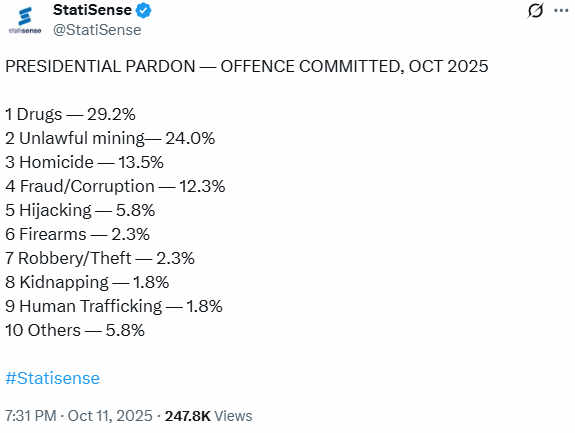
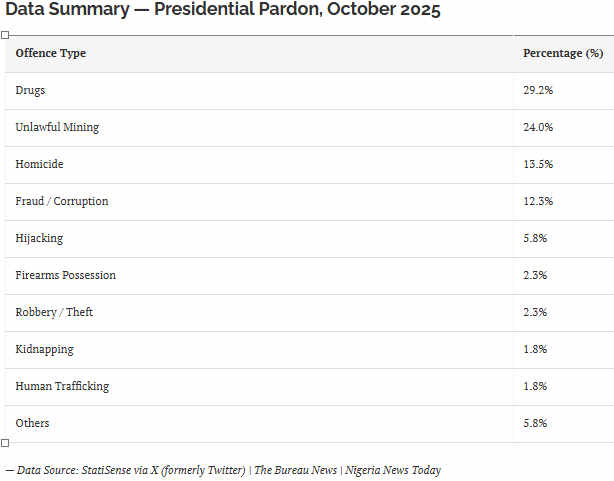
The figures, published by StatiSense on its verified X (formerly Twitter) handle and obtained by The Bureau News, reveal that 29.2% of pardoned individuals were serving sentences for drug offences, while 24.0% were convicted for unlawful mining — a crime that has become increasingly prevalent amid Nigeria’s struggle against illegal resource extraction.
Breakdown of Pardoned Offences The data reviewed by StatiSense highlights the range of criminal convictions included in the presidential clemency list: Offence Type Percentage (%) Drugs — 29.2% Unlawful Mining — 24.0% Homicide — 13.5% Advertisements Fraud / Corruption — 12.3% Hijacking — 5.8% Firearms Possession — 2.3% Advertisements Robbery / Theft — 2.3% Kidnapping — 1.8% Human Trafficking — 1.8% Advertisements Others — 5.8% In total, 175 individuals reportedly received either release or sentence reductions as part of the clemency exercise.
Background to the Clemency President Tinubu’s pardon also included posthumous recognition of prominent figures, such as: Major General Mamman Vatsa — executed in 1986 over alleged coup involvement, Environmental activist Ken Saro-Wiwa, Nationalist Herbert Macaulay.
The pardons were granted following recommendations from the Presidential Advisory Committee on the Prerogative of Mercy (PACPM).
Praise and Backlash While some have lauded the exercise as an act of compassion and reconciliation, others argue that freeing individuals convicted of serious offences like drug trafficking, illegal mining, and corruption may undermine deterrence and public trust in the justice system.
Security analysts also note that the high proportion of drug and mining-related offences on the list reflects deeper systemic challenges — including poverty, weak regulation, and inadequate rehabilitation frameworks