





Penultimate Friday, a jubilant convoy of 32 family members and friends departed Ungwan Dantsoho, Kaduna State for Qua’an Pan, Plateau State to celebrate Rabi’a Sani’s wedding. But their white 18-seater bus laden with kolanuts and wedding gifts veered off course and stopped in Mangun village, Mangu Local Government Area, to seek direction.To their utmost shock, the travelling party was attacked by hoodlums even after they had told their attackers that they were travellers from Kaduna State on the way to a wedding in Jos, Plateau State capital.Eyewitness accounts said the assailants attacked without warning and set the bus in which the strangers were travelling ablaze, killing 13 of them with many burnt beyond recognition.
Nine of the victims were buried at Hayi Burial Ground, Mangun while four others were laid to rest in Qua’an Pan after their families’ consent was secured for their burial in Plateau State to avoid possible reprisals.Narrating their ordeal, Bashir, one of the lucky survivors, said: “We had missed our way, so we stopped to ask for direction. I stepped out to talk to some young men in the village, but their faces suddenly changed.
“One of them said let’s go and attack them and set their vehicle ablaze.’’
According to Bashir, the driver tried to make a U-turn so they could escape, but the attackers had already blocked the road with logs of wood.Panic spread like wildfire inside the 18-seater bus, which had left Ungwan Dantsoho in Kaduna for Qua’an Pan, Plateau State, carrying 32 people, mostly family members heading to a wedding.Sensing danger, Bashir removed his long Jalabia, disguised himself in a short and armless shirt, and flagged down a commercial motorcycle. Pretending to be looking for a police station over a personal misunderstanding, he got the bike man to take him toward a military checkpoint.
But even the bike man sensed something was amiss and abandoned him before getting to the checkpoint. “I approached the soldiers and told them everything. I begged them to help us,” Bashir said.“By the time we got back, the hoodlums had already set the bus ablaze and killed anyone who tried to escape. They hacked the driver to death and threw his body back into the burning vehicle.”It was the intervention of the soldiers that saved the few survivors—burnt, macheted, bloodied but breathing.
“My uncle was among those hacked to death. He tried to run but didn’t know his way around the village. They caught him and killed him.“The groom’s father begged for mercy, saying we were on our way to a wedding. They killed him too,” Bashir said in a trembling voice.Another survivor, Ibrahim Umar, said they had travelled from Zaria for his cousin’s wedding.
He said: “We told them we were strangers carrying kolanuts and wedding gifts, but they didn’t listen. They just killed our loved ones—my uncle, the groom’s father and younger brother.”Umar said it was the soldiers’ arrival that prevented the death toll from being worse. “If they had not come, all of us would have died. I am sure of that,” he said.Saadu Abdullahi, another survivor, said the mob pounced as soon as they stopped to ask for directions.
“They beat us and took our phones. They didn’t care about what we said. My elder brothers and younger ones were killed,” he said.For Maimuna, one of the few female survivors, the horror unfolded in seconds.She said: “We were in touch with the groom, who told us to ask for directions if we got lost.
“When we stopped to ask, the community turned on us. We were surrounded and attacked with stones and weapons,” she said, wiping away tears.The horror was total. According to the survivors, the assailants lit the bus from the front and back. And as the passengers tried to flee, they were cut down and thrown back into the inferno.Thirteen people, including women and children, died in the attack. Dozens were injured, many of them with burns and machete wounds.
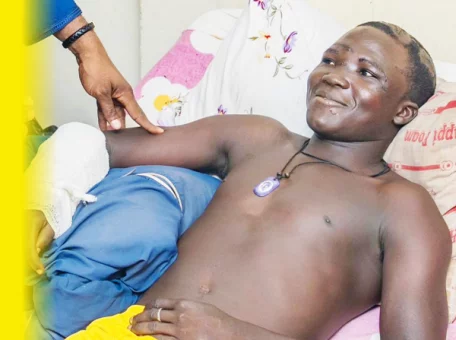
At the centre of the pain is the groom, Rabi’u Sani, whose special day turned into a lifelong scar.Sani said: “My father and other elders had advised that we go ahead with the wedding because the guests were running late.“We were so joyful after the wedding. Then I received a call while praying. The person told me our people had been attacked.
“I called back, but no one picked. When I finally spoke to a survivor, I broke down.“My father, two brothers and uncle were dead. My wedding became the reason they died.”Sani pleaded for justice, saying: “I met Governor Mutfwang in the hospital. I told him our pain is deep. We need justice. If the killers walk free, we will never heal.”
For the victims’ families, healing may take a lifetime.Malama Faji Sani Ibrahim, mother of the groom, lost her husband, two children, and two in-laws.“I don’t want to believe this is real. My husband was the breadwinner. How do we survive now?” she cried.
“I’m calling on the government to compensate us and support the orphans.”Haruna Idris, the groom’s brother, said 32 people boarded the bus. “Initially, we were told nine people had died, then 11. Then more bodies were recovered.“They stopped updating us to avoid panic. But we accept this as Allah’s will.”
The ambush occurred in Mangun community of Mangu Local Government Area of Plateau State around 8pm penultimate Friday. .Kaduna State Governor, Senator Uba Sani, has since visited the bereaved Ungwan Dantsoho community in Kudan LGA to commiserate with families of the 12 Kaduna indigenes murdered in the attack.“The right to move freely and live in any part of Nigeria is sacrosanct,” he told the grieving crowd.
“This attack is a direct assault on our constitution. We must not allow such evil to go unpunished.”