





By the Federated union of community newspaper publshers of Nigeria
In the discourse of contemporary African sociology, the intersection between acquired professional intellect and inherited cultural responsibility often presents a delicate baseline. For centuries, the structural preservation of identity has relied not merely on the existence of traditions, but on the caliber of individuals who step forward to anchor them. Within the historic Igbuzo (Ibusa) Kingdom of Delta State, this delicate balance is currently finding expression.
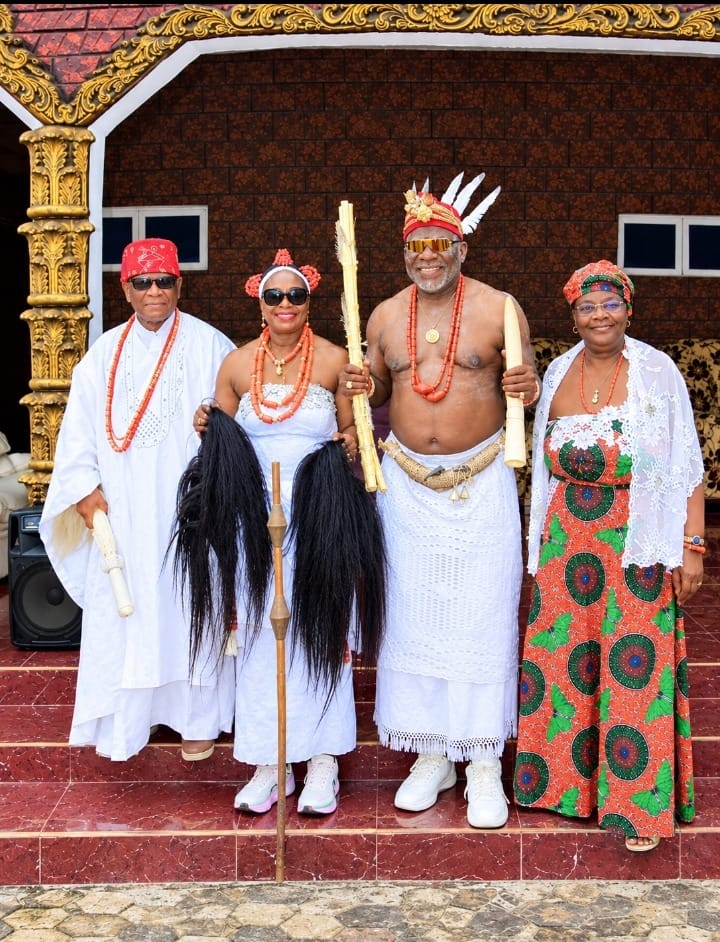
The community is marking the second anniversary of the ascension of Obi (Dr.) Henry Chukwuma Ajudua (Obi Eze Udo I of Igbuzo) to the highly revered patrician institution of Obiship—an elevation that occurred in late 2024 amidst deeply significant traditional rites.
To analyze this two-year milestone with intellectual honesty requires moving past the superficiality of mere pageantry.
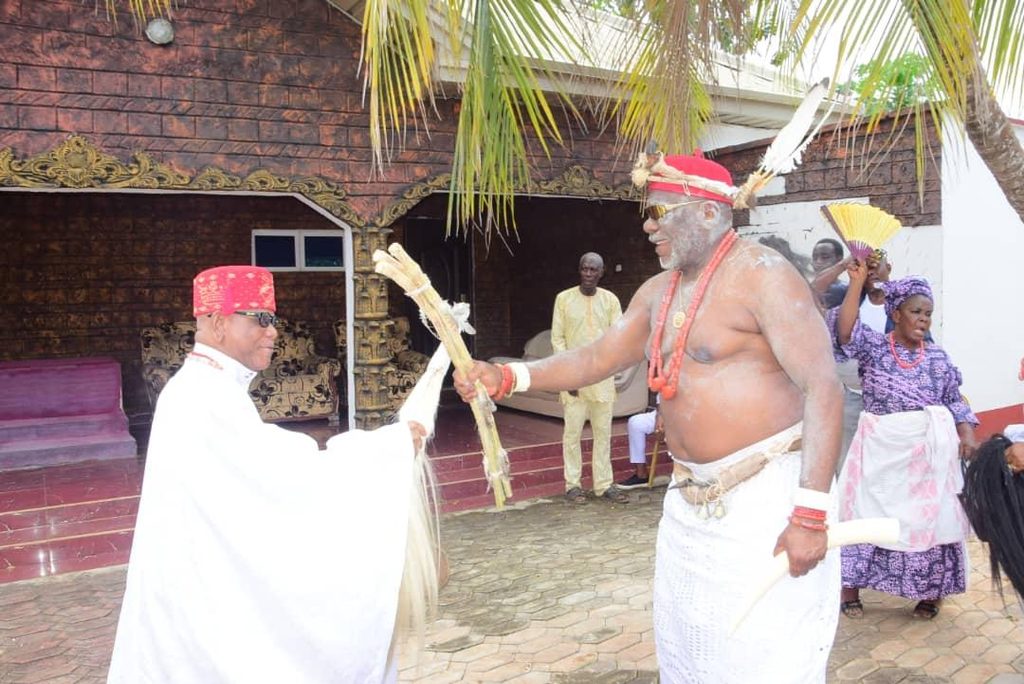
In Igbuzo, where the Obuzor remains the paramount traditional ruler, the title of Obi represents an elite attainment of nobility, leadership, and communal stewardship.
It is an institution designed for those who possess both the material independence and the philosophical discipline to act as pillars of the society. Over the last 24 months, Obi Dr. Henry Ajudua—a United States-based medical practitioner and corporate executive—has demonstrated that true nobility is an active verb rather than a passive status. His tenure has lent credence to the timeless English proverb: "Actions speak louder than words."
A society is fundamentally measured by how it shields its most vulnerable members. Long before he assumed his ancestral seat among the titled nobles of the land, Dr. Henry Ajudua understood that to whom much is given, much is expected. Through the Vebron Carre Foundation, a humanitarian organization he leads alongside his counterpart, Obi Okpoho Dr. Vivian Onyebuchi Henry-Ajudua, he has established structured interventions that transcend the temporary nature of typical political charity.
Rather than engaging in sporadic handouts, the foundation has institutionalized its support mechanisms.
Over the past two years, the palace’s philanthropic frameworks have addressed structural gaps through educational assistance, localized medical outreaches, and communal welfare interventions.
This methodical approach to community development aligns with the profound perspective of the great African statesman Nelson Mandela, who noted: "Charity can be selective, but justice must be total."
By transforming personal success into collective empowerment, Obi Ajudua has utilized his platform to stabilize local economics, foster civic harmony, and mitigate the social pressures that drive youth vulnerability.
In an era of rapid globalization, indigenous identities risk becoming historical footnotes if they are not actively articulated on global platforms. A core achievement of Obi Ajudua’s second year has been his conscious deployment of cultural diplomacy to elevate the profile of the Anioma nation.
It served as a vital intellectual bridge connecting the history of the Enuani people with the contemporary African diaspora.
By explicitly framing cultural heritage as an essential resource for historical consciousness and economic collaboration, Obi Ajudua acted as an authentic ambassador.
He proved that an ancient tradition can remain unapologetically rooted in its origins while participating meaningfully in international conversations.
The structural integrity of Obi Ajudua’s office is further reinforced by the intellectual partnership of his wife, Obi Okpoho Dr. Vivian Henry-Ajudua.
An accomplished healthcare professional and mentor, her role within the community demonstrates the value of shared purpose in leadership.
In the architecture of traditional Anioma leadership, the Obi Okpoho is not a decorative presence; she represents a distinct tier of maternal authority and grassroots advocacy. Dr. Vivian Henry-Ajudua has consistently given depth to this institutional expectation, utilizing her professional background to champion healthcare awareness, family stability, and mentorship for young women. This unified approach to community service confirms that when integrity and discipline form the foundation of a home, the public output is invariably one of enduring communal value.
As the Ibusa Community Development Union (ICDU) and various stakeholders look back on the last 24 months, the narrative that emerges is one of objective, measurable progress.
Obi Dr. Henry Chukwuma Ajudua has managed to navigate the responsibilities of his professional life in the West alongside his obligations as an elder and noble in his homeland.
His leadership offers a compelling template for the modern African elite, demonstrating that the acquisition of Western education and corporate influence does not require the abandonment of one's ancestral identity.
Two years represent only the opening chapters of what promises to be a lengthy and impactful legacy.
As the community reflects on this milestone, the prevailing sentiment is anchored in the classic proverb:
"A good name is rather to be chosen than great riches." Through quiet diplomacy, calculated philanthropy, and an unwavering respect for the rule of law and community structures, Obi Eze Udo I has laid a solid foundation for an era defined by stability, intellectual growth, and cultural dignity.