





An Opinion By Chimezie Obi Esq., President-General, Obosi Development Union Worldwide
Nigeria stands at a crossroads. Fourteen years of insecurity, grinding poverty, wasteful governance, and stunted development have left citizens asking one painful question: Is this the federation our founding fathers envisioned?
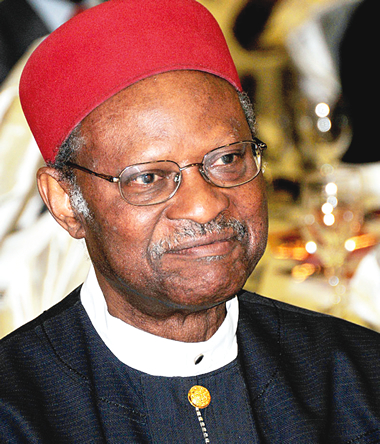
For over a decade, one of our most distinguished sons — His Excellency, Chief Dr. Emeka Eleazar Anyaoku, CFR, former Secretary-General of the Commonwealth — has offered us the answer, consistently, courageously, and relentlessly: Nigeria must return to a true regional form of government.
As President-General of Obosi Development Union and as a lawyer sworn to uphold justice and good governance, I believe it is time we amplified this call not as mere commentary, but as a national project for survival.
Chief Anyaoku did not stumble into this position yesterday. Since 2012, he has used every major national platform to argue that Nigeria’s current structure — 36 states plus FCT, with a bloated federal center — is constitutionally and economically unsustainable.
At a lecture organized by Youth Affairs International Foundation, he declared: “For the country to effectively face the challenge, we do need to return the structure of our governance to a regional system. I recall that there was healthy competition during the era of regional system.”
This was the first major public restatement in the 4th Republic that the regions, not the 36 states, were the viable federating units.
At the 4th Emeka Anyaoku Lecture on Good Governance in Abeokuta, and the 3rd Goody Jidenma Lecture in Lagos, he was direct: “called for a return to regional system of government where the country would be ran along six geo-political zones”. He described the presidential system as “wasteful” and noted: “We were a lot better when we had a federation of four regions.” He also argued that “the money gulped by 36 states is killing the economy.”
As Chairman of the Akintola Williams Distinguished Lecture Series, he warned: “unless Nigeria goes back to regional government, it may be embarking on an endless, fruitless search for meaningful development.”
From Enugu symposia to Abuja policy dialogues, Chief Anyaoku has repeated the same thesis: abolish the 36 non-viable states, and return to six federating regions aligned with our geo-political zones. His argument has never changed because the problem has never changed.
As a lawyer, I am drawn to Chief Anyaoku’s reasoning because it is rooted in law, history, and economics:
The current 36-state structure means 36 governors, 36 assemblies, 36 bureaucracies. “A major proportion of the country’s resources is spent on administration”, leaving little for capital development. Regions will cut recurrent expenditure drastically.
Under the 1960-1966 regional system, Western, Eastern, and Northern Regions competed in education, agriculture, and industry. That competition produced the Cocoa House, UAC, free education, and groundnut pyramids. Regions develop at their own pace.
Insecurity thrives where governance is distant. Regions are closer to the people, understand local peculiarities, and can legislate on policing, education, and resource management without waiting for Abuja.
Our 1999 Constitution pretends to be federal but functions as unitary. Chief Anyaoku’s call is for “returning Nigeria to true federalism”.
Chief Anyaoku has not just diagnosed the problem. As a diplomat, he has pointed to the legal path forward. There are two constitutional routes:
Option A: Sections 8 and 9 of the 1999 Constitution provide for amendment. The National Assembly, in conjunction with State Houses of Assembly, can:
- Repeal the provisions creating 36 states as federating units,
- Insert a new Chapter recognizing 6 Regions: North-West, North-East, North-Central, South-West, South-East, South-South.
- Devolve powers from the Exclusive Legislative List to the Regions. Items like Police, Mines, Railways, and Education should become regional.
- Allow regions to control resources within their territory and pay agreed percentage to the center, as was done under the 1963 Constitution.
This is faster and preserves the corporate existence of Nigeria.
Option B: New Constitution/Constitutional Conference. Convene a Sovereign National Conference of elected regional representatives to draft a new people’s constitution that entrenches regionalism. This was the path taken in 1960 and 1963. It allows us to reset the basis of our union.
In both cases, the 6 geo-political zones already exist administratively. They have zonal offices, zonal development commissions, and political consensus. They are ready-made regions.
In the arrangement, the roles of traditional rulers and town union leaderships should be encouraged and empowered.
This is where bodies like the Obosi Development Union must rise. Nations are not built in Abuja alone. They are built in town halls, in palaces, in market squares.
In order to secure this, we must:
- Educate our people on what regionalism means — not secession, but efficiency.
- Pass resolutions at the local, state, and zonal levels demanding constitutional amendment.
- Lobby our legislators to sponsor bills aligning with Chief Anyaoku’s template.
- Speak with one voice across the length and breadth of Nigeria that we are tired of a system that eats money and produces nothing.
For 14 years, His Excellency, Chief Emeka Anyaoku has not wavered. From 2012 in Awka to 2026, his message has been the same: Return to regional government or continue in endless frustration.
History will not forgive us if we ignore the counsel of our elders. The cost of maintaining 36 states is the cost of our children’s future. The cost of centralization is the cost of our security.
As President-General of Obosi Development Union, I join Chief Anyaoku in this endless and relentless call. Let the National Assembly begin the amendment process now. Let the President convene stakeholders now. Let Nigerians debate this now.
Nigeria worked before under regions. It can work again.
The time for regionalism is not tomorrow. The time is now.
May God bless Chief Emeka Anyaoku for his patriotism. May God bless the Federal Republic of Nigeria.