




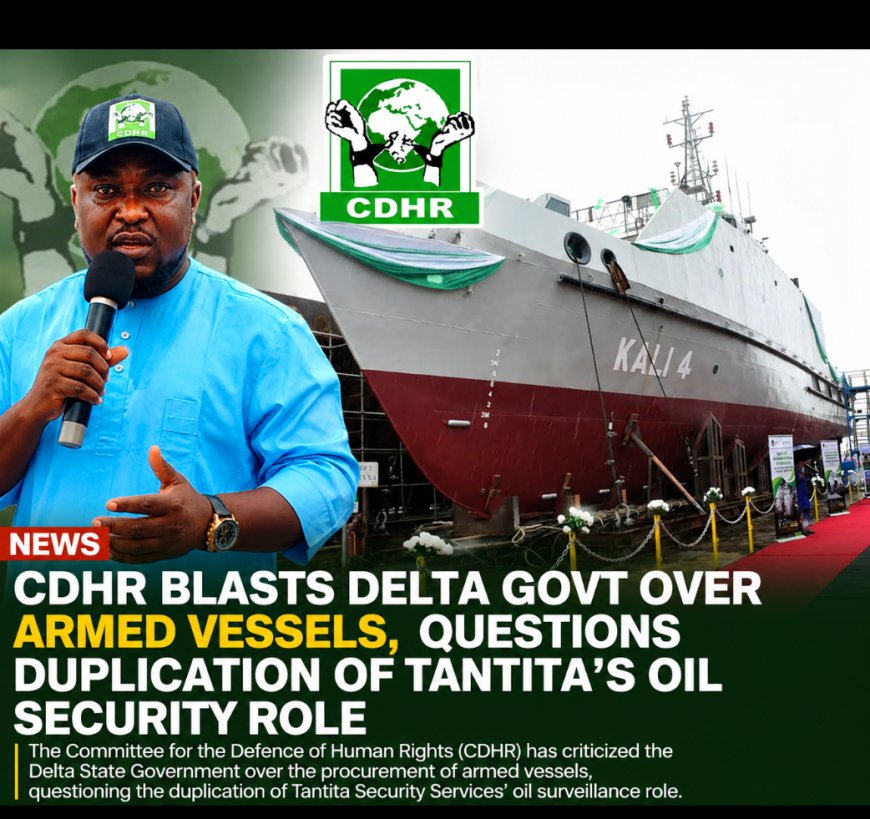

The Committee for the Defence of Human Rights (CDHR), Delta State Branch, has strongly criticised the Delta State Government over its purchase of armed vessels purportedly to protect oil and gas assets and combat oil theft, describing the expenditure as a misplaced priority and an unnecessary duplication of an existing federal security arrangement.
The rights group questioned the justification for the state government’s investment in armed vessels when the Federal Government has already engaged Tantita Security Services Nigeria Limited to monitor and secure critical oil and gas infrastructure in the Niger Delta.
In a statement signed by the Chairman of CDHR Delta State Branch, Comrade Derrick Oritsematosan Agberen, and the Publicity Secretary, Comrade Godswill Nosa Overseey, on August 20, 2026, and made available to newsmen in Warri, the organisation demanded transparency over the acquisition and intended deployment of the vessels.
CDHR asked why Delta State should commit public resources to a security responsibility it said fundamentally belongs to the Federal Government, particularly when Tantita has already invested heavily in boats, drones, surveillance technology and manpower for the protection of oil facilities and waterways.
“Was Tantita Security Services Nigeria Limited not contracted by the Federal Government to survey and secure oil facilities? Tantita has invested heavily in modern technology, boats, drones and manpower for this purpose, which we have seen results in recent times,” the group said.
According to CDHR, the existence of an established federal arrangement for oil and gas security raises serious questions about the rationale for Delta State establishing what appears to be a parallel maritime security structure.
The organisation called on the Delta State Government to explain the circumstances surrounding the purchase, including the cost, procurement process, operational mandate and specific responsibilities assigned to the vessels.
It also questioned whether the acquisition was properly coordinated with the Federal Government and relevant security agencies responsible for the protection of the nation's oil and gas infrastructure.
CDHR warned that government must avoid creating overlapping security structures that could result in unnecessary expenditure and confusion over operational responsibilities.
The group said, “Security of oil and gas infrastructure is on the Exclusive Legislative List. The Federal Government has already delegated this responsibility to a private security outfit. Why is Delta State duplicating the same role?”
It further urged the state government to make the entire process transparent to Deltans, stressing that taxpayers have a right to know how public funds are being deployed.
CDHR said that if the Delta State Government genuinely wants to intervene in federal assets located within the state, it should focus its energy and political influence on projects capable of transforming the state's economy.
The organisation specifically called for renewed efforts towards the revival of the Delta Steel Company, Aladja, and the full commencement of operations at the Warri Port, arguing that both facilities could generate thousands of jobs and create substantial economic opportunities for Deltans.
“If the State Government is keen on intervening in federal projects located in Delta, why not engage the Federal Government on the revival of Delta Steel Company, DSC Aladja, and the full commencement of NPA Warri Port? Both can create thousands of jobs and wealth for our people,” CDHR said.
While acknowledging the importance of protecting oil and gas infrastructure, CDHR said the state government's intervention would be more productive if resources were channelled into contemporary surveillance technology.
It suggested the use of drones, helicopters and other modern monitoring systems to support existing security arrangements rather than maintaining parallel armed maritime capabilities.
The group also argued that sustainable employment and industrial development remain among the most effective ways of tackling oil theft, vandalism and other criminal activities in the Niger Delta.
“More importantly, government should build industries to create employment. Job creation is the surest way to discourage oil theft and vandalism,” it said.
CDHR described the expenditure on armed vessels as particularly difficult to justify while major economic assets such as DSC Aladja remain moribund and the Warri Port is yet to realise its full commercial potential.
The organisation therefore urged the Delta State Government to ensure that the newly acquired vessels are deployed strictly for legitimate, clearly defined security purposes and that their operation does not create unnecessary duplication with existing federal security arrangements.
CDHR also called for greater collaboration between the state government, the Federal Government, security agencies and existing private security contractors such as Tantita Security Services Nigeria Limited, whose investments in maritime surveillance and oil infrastructure protection, it noted, have become increasingly significant in the Niger Delta.
The rights group maintained that the ultimate objective should not simply be the acquisition of more armed platforms, but the development of a coordinated security architecture backed by transparency, technology, employment creation and economic development.
It urged Governor Sheriff Oborevwori's administration to make the protection of public funds and the economic welfare of Deltans the central consideration in the deployment of state resources.