




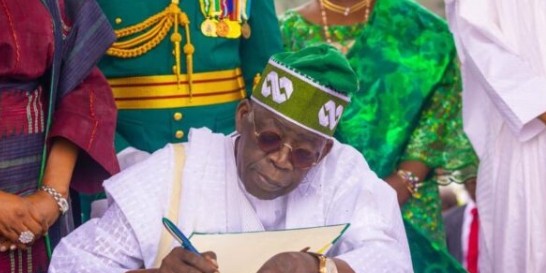

President Bola Ahmed Tinubu has signed the Electoral Act 2026 into law, introducing significant changes to the grounds on which election results can be challenged in Nigeria.
The new law, signed on February 18, 2026, after its passage by the National Assembly, is expected to guide the conduct and legal challenges arising from the 2027 general elections. One of the most significant changes is the removal of questions surrounding certificate forgery, age falsification and false declarations as grounds for challenging an election result after voting has taken place. Under Section 138 of the new Electoral Act, an election can now be challenged mainly on two grounds.
The first is where the election was invalidated by corrupt practices or a failure by electoral officials to substantially comply with the law. The second is where the person declared the winner did not secure the majority of lawful votes cast.
The implication is that allegations concerning whether a candidate submitted a forged certificate, falsified their age or made a false declaration may no longer be relied upon to ask an election tribunal to nullify an election after the results have been declared.
This marks a departure from the Electoral Act 2022, which allowed election petitions to challenge the qualification of a candidate after an election.
Under the new framework, qualification-related issues are expected to be addressed before election day rather than through post-election litigation. Forgery Remains a Crime The new law, however, does not legalise forgery or protect anyone from criminal prosecution for submitting false documents.
The 1999 Constitution contains provisions on the qualification of candidates who present forged certificates, while forgery itself remains a criminal offence under Nigerian law. The major change is the stage at which such matters can be raised.
APC National Publicity Secretary, Felix Morka, has also maintained that the Electoral Act does not make certificate forgery legal.
The Independent National Electoral Commission (INEC) has similarly backed the interpretation that questions relating to a candidate’s qualification should be dealt with before the election rather than through a post-election petition.
This means political parties, candidates and other interested parties may have to scrutinise candidates’ certificates, age claims and other qualification requirements before Nigerians cast their ballots.
Heavy Penalties for Improper Election Petitions The new Electoral Act also introduces financial penalties for lawyers and petitioners who pursue issues outside the grounds permitted under the law.
Lawyers who bring matters that fall outside the prescribed grounds may face a fine of at least N5 million, while petitioners may be liable to a minimum fine of N10 million.
The provisions are expected to discourage what lawmakers consider frivolous or improperly grounded election petitions. New Law Sparks Controversy The passage and signing of the legislation within a short period have generated debate among political actors, lawyers and members of the public.
Critics have questioned whether the new provisions could give elected politicians an advantage over ordinary Nigerians, particularly in cases involving allegedly false certificates or personal information.
They argue that ordinary citizens who submit forged documents can face serious consequences, including job losses, blacklisting and criminal prosecution, and question why similar allegations involving political candidates should have limited relevance after an election.
Legal experts have also raised questions about the relationship between the Electoral Act and the 1999 Constitution.
The Constitution remains Nigeria’s supreme law, meaning that an ordinary Act of the National Assembly cannot override a constitutional provision. As a result, legal challenges seeking to determine the constitutionality and interpretation of some provisions of the new Electoral Act are expected to continue.
With the 2027 general elections approaching, the new legislation is likely to become a major issue for political parties, candidates, lawyers and voters. The Electoral Act 2026 has effectively shifted the focus of disputes over certificates, age claims and other qualification matters from the post-election courtroom to the period before Nigerians go to the polls.