




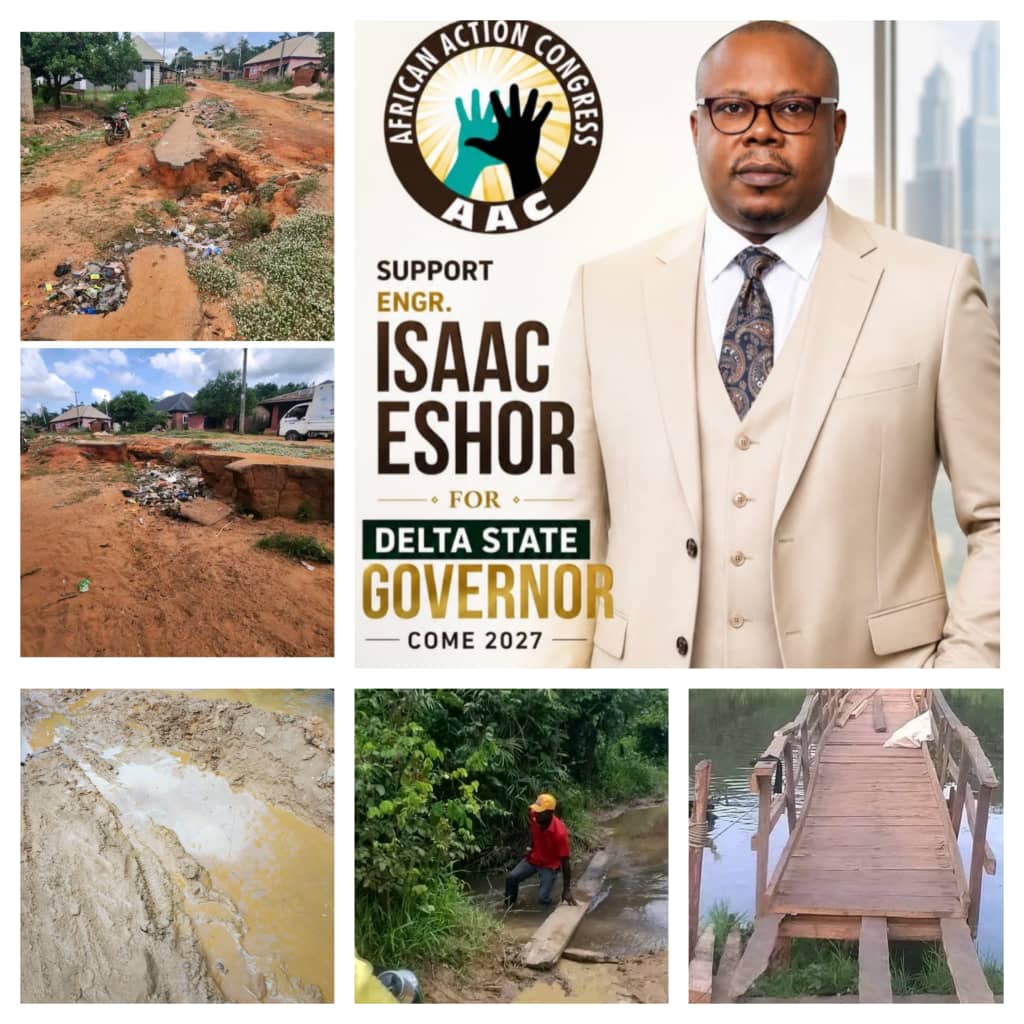

By Ugochukwu Benson & Celestine Ese
The African Action Congress (AAC) governorship candidate for the 2027 Delta State governorship election, Engr. Isaac O. Eshor, has criticized the state of infrastructure across Delta State, particularly the deplorable condition of rural roads, despite what he described as the state's enormous financial allocations.
Speaking during an exclusive interview with some Grassroots Newspaper Publishers in Asaba on Thursday, Eshor outlined his vision for Delta State, expressing confidence that he can unseat the incumbent administration in 2027. He also spoke on governance, infrastructure, and the politics of equity.
Question: Your Excellency, sir, can we meet you?
Engr. Isaac O. Eshor: My name is Engr. Isaac O. Eshor, and I am a proud son of Ebu Town in Oshimili North Local Government Area of Delta State. I am a Maritime Engineer, entrepreneur, employer of labour, International Ambassador to Intercap Nigeria, Founder of the Focus Foundation, and the governorship candidate of the African Action Congress (AAC) for the 2027 election.
Question: You are contesting for the governorship of Delta State under the African Action Congress (AAC). What makes you believe you can defeat an incumbent governor?
Engr. Isaac O. Eshor: Thank you very much. It will not be the first time in Nigeria that a sitting governor has been defeated. When a government fails to meet the expectations of the people, the electorate has the power to vote for new leadership.
Delta State belongs to all of us. Looking at the huge resources and monthly allocations accruing to the state, I believe the present administration has performed below expectations. The level of development does not reflect the enormous resources available to the state.
Let me begin with my hometown, Ebu. For over 30 years, my people have lived without basic social amenities. The major economic road linking Ebu to neighbouring communities has collapsed, effectively cutting the community off from surrounding towns. Today, the only access route is through the federal road via Illah, which is also in a deplorable condition.
The road in Ebu was last constructed during the administration of former Governor James Ibori about three decades ago. Since then, successive governments, including the current administration, have not done enough despite repeated appeals by the people.
The situation is not limited to Ebu. In Ashama, Aniocha South Local Government Area, and several other communities, there are virtually no motorable roads, and residents depend largely on motorcycles for transportation.
Similar infrastructure challenges exist across Delta Central. The Orhoakpor–Ododegho–Ughelli Road in Ethiope East Local Government Area has remained in a deplorable condition for a long time.
I visited Asaba-Ase through Uzere in Delta South and several other communities without proper link roads, and I felt deeply concerned. The government has announced the ongoing construction of several flyovers, but with the huge revenue accruing to Delta State through federal allocations, I believe it is possible to build flyovers while also constructing and rehabilitating major roads linking communities across the state.
Delta State has the financial capacity to execute these projects. Our allocation for 2025 was about ₦936 billion, excluding internally generated revenue. In terms of federal allocations, Delta State remains one of the richest states in the country.
Question: If elected governor, do you believe you can perform better than the present administration?
Engr. Isaac O. Eshor: Yes, I do. Within two years, I will focus on opening up major link roads connecting neighbouring towns and villages because we have the resources to do so.
Our people are suffering. Farmers find it difficult to transport their produce to markets because of bad roads.
Infrastructure is the foundation of economic development.
When you compare what states like Abia and Enugu are doing with their available resources, it raises serious questions about whether Delta State's enormous financial resources are being effectively translated into meaningful development. In my opinion, the answer is no.
Question: How do you intend to defeat the incumbent governor in the 2027 election?
Engr. Isaac O. Eshor: Time will tell. I will not disclose my campaign strategies at this stage, but I am fully in the race to win the governorship election in 2027.
Question: Some people argue that Delta State's governorship follows an equity arrangement and that it is now the turn of Delta Central to complete eight years after Anioma. What is your position?
Engr. Isaac O. Eshor: Is that arrangement contained in the Nigerian Constitution? We operate a democratic system, and my party does not believe in zoning or power rotation as a binding principle.
We believe leadership should be based on competence, capacity, integrity, and the ability to deliver good governance. I am consulting widely across the state, and I believe Deltans will ultimately decide who has the vision and competence to move the state forward.