




When U.S. President Donald Trump publicly warned that the killing of Christians and civilians in Nigeria must stop, few expected Beijing—not Abuja—to respond first. Yet within hours, China issued a sharp statement advising Washington to “respect Nigeria’s sovereignty” and avoid interfering in its internal affair.
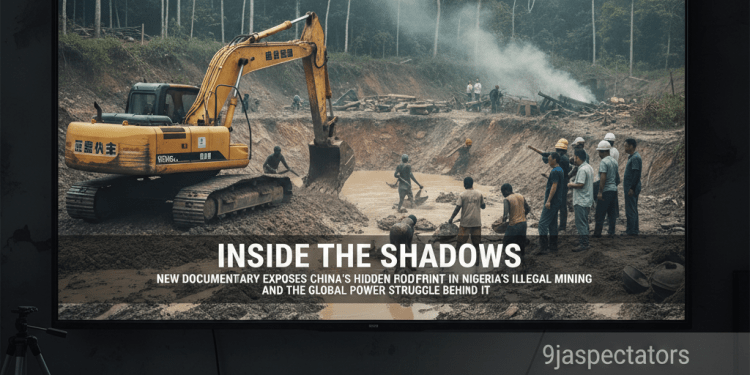
A new video documentary obtained by 9jaspectators argues that this reaction was no accident. Instead, it connects Beijing’s response to a long, quietly growing web of influence that China has spun across Nigeria’s most mineral-rich regions—one that could unravel under U.S. scrutiny.
What emerges from the documentary is not a simple geopolitical disagreement, but a high-stakes conflict over minerals, money, and global influence, with Nigeria at the centre.
A Warning That Revealed More Than Intended
The filmmakers point out that China’s statement never addressed the killings. It did not condemn the violence ravaging northern states, nor call on authorities to protect civilians.
Its only concern was the U.S.
Why? According to the documentary, “because transparency is China’s greatest fear in Nigeria.”
The film suggests that Beijing’s economic footprint has grown far beyond legitimate infrastructure loans and construction projects—and deep into a network of illegal mining, unaudited mineral exports, and political patronage.
A Map of Minerals and Manipulation
The documentary outlines how Chinese companies and individuals are heavily present in mining zones across:
Zamfara – illegal gold sites long linked to armed group activity
Niger State – gold and lithium corridors controlled by local militias
Nasarawa – communities alleging Chinese firms pay armed groups for “security”
Kogi – state authorities battling environmental devastation blamed on mining firms
While some Chinese-run mines are registered, many operate without licenses, often secured through local middlemen or politicians the documentary claims are “bought into the system.”
Nigeria’s Minister of Solid Minerals has already publicly confirmed that illegal mining finances terror groups. The documentary argues that Chinese buyers—seeking cheap, unregulated minerals—benefit from the chaos.
The Lithium War: A Battery-Powered Silence
One of the film’s most striking segments focuses on lithium, the mineral powering electric vehicles and the global race for green technology.
Nigeria holds some of Africa’s largest untapped deposits.
The documentary alleges that:
Large quantities of Nigerian lithium leave the country without proper documentation.
Some shipments end up in Chinese supply chains.
Local officials receive bribes to ignore irregularities.
“Lithium is China’s new oil,” the documentary states. “And Nigeria is one of the easiest places to extract it quietly.”
According to the filmmakers, U.S. involvement threatens to expose these flows—explaining Beijing’s hostility toward Trump’s remarks.
Infrastructure or Leverage?
The documentary widens the lens to China’s broader strategy in Africa through the Belt and Road Initiative.
Nigeria’s loans from China exceed $5 billion on record, but sources interviewed suggest the real figure may be higher when indirect financing and state-backed corporate deals are included.
The documentary argues that these infrastructure projects—railways, bridges, airports—are rarely acts of goodwill. Instead, they are “debt anchors” that increase political leverage.
“When a government owes millions to the lender building its roads,” the narrator says, “that lender gains a voice in how the country is run.”
A Triangle of Silence: Politicians, Foreign Investors, and Violence
The documentary presents testimonies from locals, whistleblowers, and policy analysts who claim Nigerian political elites are integral to the mining network.
Allegations include:
Politicians collecting “security fees” from illegal miners
Local chiefs granting access to mineral sites in exchange for kickbacks
State officials shielding foreign firms during crackdowns
Mineral exports disappearing without being captured in official records
One mining community leader interviewed says, “When you see illegal Chinese miners, just know someone in government gave them the green light.”
This “triangle of silence”—foreign buyers, local politicians, and armed groups—creates conditions in which minerals move freely while violence grows unchecked.
Why Beijing Fears Washington
The documentary argues that U.S. interest in Nigerian security and religious freedom is not just moral—it brings audits, investigations, and satellite-backed intelligence.
These tools could:
Map illegal mining sites
Track mineral shipments leaving Nigeria
Identify shadow companies exporting to Asia
Pressure Nigerian leaders to release mining contracts
Demand transparency on Chinese loan agreements
For China, the documentary claims, this level of scrutiny could unravel years of opaque deals and expose the financial architecture that supports illegal mining networks.
“Chaos keeps the system alive,” the narrator says. “Order destroys it.”
Caught in the Middle: The Nigerian People
While global powers circle and politicians negotiate behind closed doors, ordinary Nigerians—especially in mining communities—are left with poverty, polluted water, destroyed farmlands, and insecurity.
The documentary describes:
Villages displaced for mining
Rivers contaminated by unregulated digging
Youth recruited by armed groups guarding mineral sites
Communities living next to billion-dollar deposits but lacking electricity
The tragedy, the film argues, is not just exploitation—but the absence of leaders willing to confront it.
“We See You”: Why Trump’s Statement Caused Panic
According to the filmmakers, Trump’s comments signalled the possibility of deeper U.S. involvement. For Beijing, it wasn’t the statement itself, but what it could trigger:
International investigations
Human rights audits
Mineral-export monitoring
Transparency demands on Chinese companies
Pressure on Nigerian leaders to explain missing revenue
The documentary asserts that China’s warning to the U.S. was not about protecting Nigeria’s sovereignty, but about shielding an economic empire built on opaque practices.
A Country at a Crossroads
The documentary concludes with a stark message:
China does not fear America because it cares about Nigeria; it fears America because the truth could expose years of hidden deals.
And Nigeria’s leaders, caught between debt, politics, and personal interests, remain silent.
“This silence,” the narrator says, “is bought. And until Nigerians start asking the right questions, that silence will continue.
