




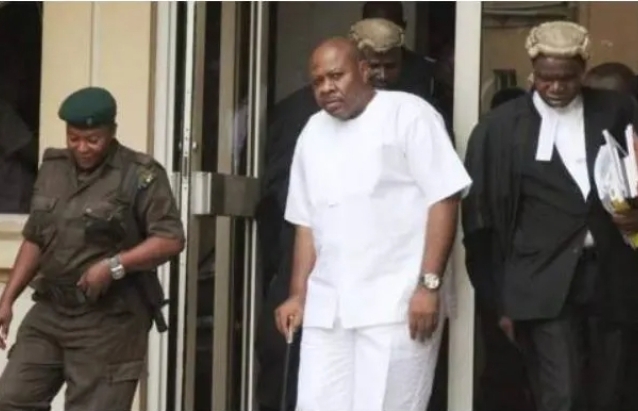

The Special Offences Division of the Lagos High Court in Ikeja has rejected a fresh bail application filed by businessman Fred Ajudua, who is currently standing trial for fraud.
Ajudua, through his counsel Olalekan Ojo (SAN), had asked Justice Mojisola Dada to grant him bail pending the determination of his trial, citing serious health challenges. Ojo informed the court that his client, who was brought to court with the help of medical personnel from the Lagos University Teaching Hospital (LUTH), suffers from chronic kidney disease.
He urged the court to allow Ajudua to attend to his medical needs, stressing that only the living can stand trial.
However, EFCC counsel Seidu Atteh opposed the request, arguing that the defendant already has matters pending before the Supreme Court and should have directed his bail application there. Atteh asked the trial court to dismiss the application.
Responding, Ojo maintained that the application before the Supreme Court was unrelated to the bail request and had no bearing on the current proceedings. He insisted that Ajudua was not seeking bail from the apex court.
In her ruling, Justice Dada said she would wait for the outcome of the Supreme Court decision and abide by it.
“In view of the applications filed at the Supreme Court, I am constrained to make any decision with respect to this instant application filed by the defence counsel. I will abide by the decisions of the Supreme Court,” the judge said.
The court adjourned the matter to October 10, 31, and November 20 for continuation of trial.
Ajudua is facing charges of allegedly defrauding a Palestinian national, Zad Abu Zalaf, of $1,043,000 under false pretences.
Before ruling on the bail application, the court heard testimony from the third prosecution witness, EFCC investigator Afanda Bashir Emmanuel. He told the court that he met Ajudua in 2005, shortly after the EFCC was established, and that the defendant’s case was transferred to the Commission by the Special Fraud Unit of the Nigerian Police Force.
Emmanuel said that during the investigation, the EFCC reached out to several institutions, including the Nigerian Police Force, the Central Bank of Nigeria, the Nigerian National Petroleum Company Limited, and the Commission’s forensic lab, to obtain documents relevant to the case.
When the EFCC attempted to tender those documents in court, the defence objected. Ojo argued that the documents were inadmissible because they were neither original nor certified true copies, and that the EFCC counsel had not laid a proper foundation for presenting photocopies.
After hearing arguments from both sides, Justice Dada admitted two of the documents into evidence and rejected the other two.
The court then adjourned to allow the defence counsel time to prepare for cross-examination of the witness.
The case, which was first filed in 2005 before Justice Morenike Obadina, has faced repeated delays due to various legal maneuvers by the defence. It was later reassigned to Justice Josephine Oyefeso and eventually to Justice Mojisola Dada. Ajudua was formally arraigned on June 4, 2018.
Following an earlier denial of bail by Justice Dada, Ajudua appealed to the Lagos Division of the Court of Appeal, which granted him bail on September 10, 2018. The EFCC challenged this ruling at the Supreme Court, which sided with the Commission and directed that Justice Dada continue with the trial. The apex court also overturned the appellate court’s decision to reassign the case to a new judge for a fresh trial.