



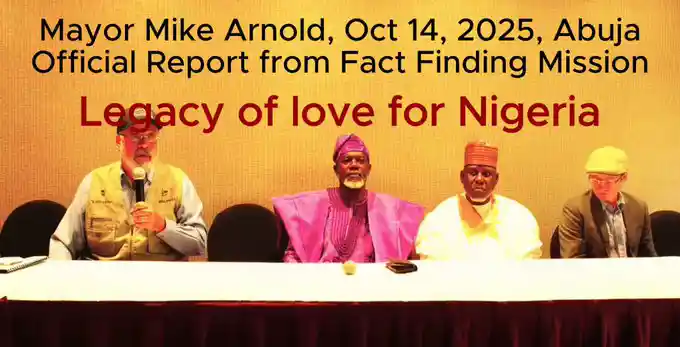

A new international Fact-Finding Mission sponsored by Nigerian activist and political commentator Reno Omokri has confirmed what it described as an “ongoing Christian genocide” in parts of northern and central Nigeria.
The mission, which reportedly operated under the awareness of the National Security Adviser (NSA), Mallam Nuhu Ribadu, found credible evidence of targeted killings, forced displacement, and systematic burning of churches across several states.
reports that the investigation was led by Mike Arnold, a U.S. citizen and independent fact-finder, who presented the group’s findings in a statement issued after visiting several violence-affected communities.
According to Arnold, the team’s fieldwork revealed that radical Islamic extremists have carried out coordinated attacks on predominantly Christian towns and villages in Nigeria’s Middle Belt and parts of the North, resulting in widespread casualties and destruction.
Findings from the Fact-Finding Mission In the official report made public on Tuesday, Mike Arnold said the mission documented extensive evidence of religious persecution, describing the situation as one that meets the United Nations’ definition of genocide.
He explained that the team’s findings were drawn from interviews with survivors, eyewitnesses, displaced persons, and local community leaders.
“Our investigation confirms that there is an ongoing Christian genocide in Nigeria perpetrated by radical Islamic jihadists,” Arnold said. “In one incident in Bokkos, Plateau State, seven churches were burnt to the ground, while no mosque was touched. Most victims we interviewed were displaced Christians now living in makeshift camps or in Cameroon.”
The mission, which covered parts of Plateau, Benue, Kaduna, Nasarawa, and Taraba States, also reported that many internally displaced persons (IDPs) have been left without official government recognition or humanitarian support. According to Arnold, these unacknowledged victims live in “invisible camps” scattered along Nigeria’s borders with Cameroon and Chad, surviving without access to basic services.
“We met thousands of displaced Christians who said their existence has been denied by the authorities. Their stories reveal a pattern of targeted violence and neglect,” he added. Scope and Methodology of the Mission The team’s work reportedly involved direct visits to affected areas, documentation of burnt properties, and interviews with victims of attacks attributed to armed militias and extremist groups.
While the mission did not name specific groups, several of the incidents referenced in its report align with previously documented attacks attributed to Fulani militias, Boko Haram, and Islamic State–West Africa Province (ISWAP).
Mike Arnold said the group maintained neutrality and independence throughout its work, insisting that the findings were based on verifiable evidence collected from multiple sources on the ground.
The mission also stated that its work was conducted with the awareness of the Office of the National Security Adviser (ONSA), suggesting that Nigerian authorities were informed of the team’s presence in the field.
Highlights of the Findings Targeted Attacks on Christian Communities Villages predominantly inhabited by Christians have faced repeated assaults, often at night. Churches and homes are burned while mosques and non-Christian buildings are left untouched.
Destruction of Religious Sites At least seven churches were confirmed destroyed in a single attack in Bokkos Local Government Area of Plateau State. In some areas, Christian clerics were reportedly targeted or abducted.
Mass Displacement The report estimates that over 9 million internally displaced persons (IDPs) in Nigeria are Christians who fled their homes due to religiously motivated violence. Many of these IDPs have crossed into neighboring Cameroon and Chad, where they remain undocumented.
Government Negligence The mission alleged that some government officials have “turned a blind eye” to the killings, while others “enable impunity by inaction.” Arnold stated that the pattern of denial from local and federal authorities contributes to the continuation of the crisis.
International Classification as Genocide Based on the UN Convention on the Prevention and Punishment of the Crime of Genocide (1948), the mission said the killings and forced displacements meet the legal threshold for genocide because they target a specific religious group with intent to destroy it in whole or in part. Quote from Mike Arnold “For Nigeria to develop and stop these killings, the truth must be told,” Arnold said.
“What we found in Benue, Plateau, and Southern Kaduna are not random acts of violence but coordinated campaigns against Christian populations. The scale of destruction is consistent with international definitions of genocide.”
He also emphasized that the mission was not politically motivated but humanitarian in purpose. “We are not here to take sides in Nigeria’s politics. We are here because human lives matter, and the truth must not be buried,” he stated.
Reno Omokri’s Role in the Mission The report confirmed that the Fact-Finding Mission was financially supported by Reno Omokri, a former presidential aide and social media activist known for his advocacy on religious freedom and minority rights. Omokri has been an outspoken voice on Nigeria’s insecurity, often highlighting attacks on Christian communities in his public statements. In several social media posts, he said his involvement in sponsoring the fact-finding mission was aimed at providing independent evidence to the global community on the scale of religious persecution in Nigeria.
“The goal is to let the world see the truth without distortion or propaganda. Too many Nigerians have died in silence. The world needs to know,” Omokri stated.
Background: Rising Insecurity in Nigeria’s Middle Belt The findings come amid increasing violence in Nigeria’s Middle Belt region, where conflicts between armed herdsmen and farming communities have led to thousands of deaths and displacements over the past decade. International human rights organizations, including Amnesty International, Open Doors, and Christian Solidarity International, have repeatedly warned that attacks on Christian communities could amount to genocide if unchecked.
According to a 2024 report by the International Society for Civil Liberties and Rule of Law (Intersociety), more than 52,000 Christians have been killed by Islamist groups in Nigeria over the past 14 years. Despite repeated government assurances, attacks have continued in Plateau, Benue, Southern Kaduna, and Taraba States, where villages are often raided and residents displaced.
Government Reaction As of press time, there has been no official response from the Federal Ministry of Information or the Office of the National Security Adviser regarding the mission’s findings. However, sources close to the Ministry of Interior said the government continues to treat all acts of violence as “criminal and communal conflicts”, rather than religious persecution. Government spokespersons have in the past maintained that terrorism and banditry in Nigeria are driven by multiple factors, including ethnic rivalries, land disputes, and socio-economic pressures, rather than purely religious motivations. Calls for International Attention The mission’s findings are expected to draw renewed attention from international human rights bodies and religious organizations.
Observers say the report could influence how the global community perceives Nigeria’s ongoing conflict. Human rights advocates are already calling on the United Nations Human Rights Council, the African Union, and the International Criminal Court (ICC) to open investigations into the allegations contained in the mission’s report. “This is not a local issue anymore,” Arnold said.
“The evidence we’ve gathered should prompt international action to protect vulnerable populations and hold perpetrators accountable.” Christian Associations React The Christian Association of Nigeria (CAN) and several church leaders have welcomed the report, describing it as “a long-awaited acknowledgment of reality.” A spokesperson for CAN, Rev. Samson Ayokunle, said the mission’s findings corroborate years of appeals the association has made to the federal government. “We have been crying for years that Christians are being targeted, killed, and displaced, yet our cries fell on deaf ears. We are glad that an independent team has now verified these facts,” Ayokunle said. “We call on the international community to act now before it becomes too late.” Analysts Urge Balanced Implementation of Recommendations Policy experts say while the mission’s findings are credible, Nigeria’s government must balance any response with national unity considerations. Dr. Ibrahim Zango, a conflict resolution specialist, told TJ News Nigeria that authorities should treat the report as an opportunity to strengthen peacebuilding. “This is a sensitive issue. The government must address it transparently but avoid actions that may deepen sectarian divides,” Zango noted.
“Independent verification of the data and dialogue with affected communities should follow.” Broader Implications for National Security The confirmation of a pattern of targeted attacks along religious lines raises serious implications for Nigeria’s internal stability and its international reputation. Security experts warn that continued silence or denial could embolden extremist elements and further alienate faith-based communities.
The report also underscores the urgent need for security reforms, improved intelligence coordination, and justice for victims of religiously motivated violence. Conclusion The Fact-Finding Mission sponsored by Reno Omokri has reignited global debate about the scope and nature of Nigeria’s internal conflicts, particularly in relation to religious freedom and human rights.
While the Federal Government is yet to issue an official response, the mission’s report adds to mounting evidence that Christian communities across parts of Nigeria face systematic persecution. The findings are now expected to spark international dialogue, renewed calls for accountability, and a reassessment of Nigeria’s human rights commitments under international law
