



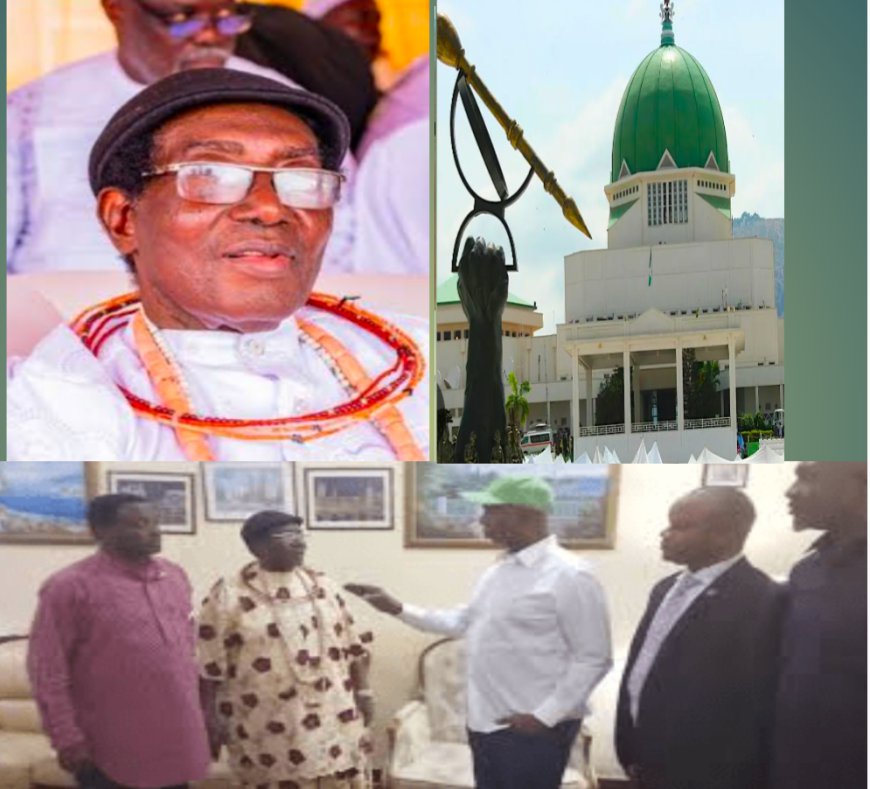

The historic achievement of Chief (Dr.) Wellington Okrika, the Bolowei of Gbaramatu Kingdom in Warri South-West Local Government Area of Delta State, in securing constitutional recognition for the 13% derivation fund has once again placed the Niger Delta at the heart of a national conversation — one that questions justice, equity, and accountability in the management of Nigeria’s oil wealth.
Fondly known as “Mr. 13% Derivation Fund,” Chief Okrika is a tireless advocate for fairness and resource control for oil-producing communities.
His work during the 1994/1995 Constitutional Conference under General Sani Abacha laid the groundwork for Section 162(2) of the 1999 Constitution (as amended), which mandates that “not less than thirteen percent of the revenue derived from natural resources shall be returned to the producing areas.”
The 13% derivation principle was designed as a justice clause — a measure to correct the historic marginalization of communities whose lands and waters have suffered decades of environmental degradation, social displacement, and economic deprivation.
During Abacha’s regime, the federal government agreed that oil-producing communities should receive their funds directly through dedicated oil commissions in each producing state. But the return to civilian rule altered this arrangement.
Politicians redirected the funds to state governments, promising that governors would channel them to the communities via state oil commissions. Over time, however, this system broke down.
Funds intended for host communities were diverted, mismanaged, or lost entirely, leaving the original intent of the derivation principle unfulfilled.
Today, what was once celebrated as a historic victory has become a symbol of an unfinished struggle — one that calls for the direct allocation of funds to oil-bearing communities.
The consequences of the current system are severe: communities living with oil spills, gas flares, and devastated ecosystems remain trapped in poverty, while the very funds meant to transform their lives are siphoned elsewhere.
Chief Okrika’s accomplishment must not be seen only as a historical milestone.
It represents the foundation of a new phase in the Niger Delta struggle — one focused on transparency, accountability, and empowerment for the communities who bear the brunt of Nigeria’s oil wealth.
His work secured the constitutional right; it is now the responsibility of the people and policymakers to ensure that right is realized in practice.
Civil society groups are rising to this challenge as the Organisation for Human and People’s Rights Protection and Humanitarian (OHPRPH), led by Ezekiel Kagbala, the Niger Delta Movement for 13% Derivation under Comrade Stella Ejiro Bobo, the Niger Delta Development Initiative led by Comrade Henry Usiayo, and the Ijaw People’s Progressive Agenda under Comrade Mavelus Doboro are collectively urging the National Assembly — particularly the Senate — to take decisive legislative action.
Their goal: enforce the constitutional provision and guarantee that funds reach the oil-producing communities directly. Correcting this anomaly would not only fulfill the spirit of the 1999 Constitution but also rebuild trust between the federal government and the Niger Delta.
The region must no longer be treated as a political playground. Its people deserve to have their voices heard, their rights respected, and their resources managed in ways that genuinely improve livelihoods.
The struggle Chief Wellington Okrika began decades ago has evolved. Today, it is the responsibility of civil society, lawmakers, and the communities themselves to ensure that the 13% derivation fund becomes more than a symbol — it must become a living instrument of justice for those who have sacrificed the most for Nigeria’s prosperity.
