




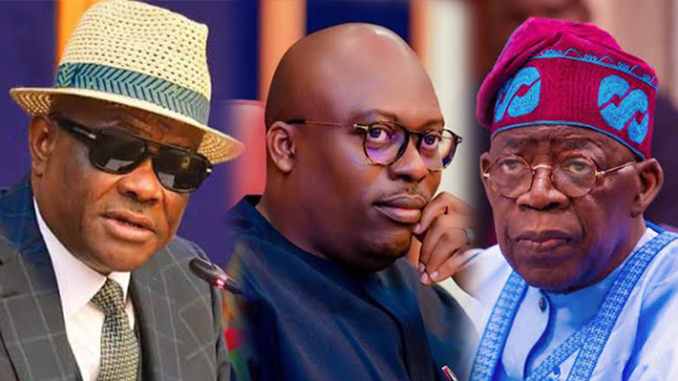

President Bola Ahmed Tinubu has waded decisively into the lingering political crisis in Rivers State, issuing a clear warning to the Minister of the Federal Capital Territory, Nyesom Wike, and his loyalists to allow Governor Siminalayi Fubara to govern the state without interference.
In a statement conveyed through his Special Adviser on Media and Policy Implementation, Daniel Bwala, the President openly canvassed support for Governor Fubara, describing him as the legitimate and undisputed leader of the ruling party in Rivers State and affirming his authority to discharge his constitutional responsibilities freely.
According to the presidency, Tinubu has made it clear that the continuous political tension in Rivers State is unnecessary and harmful, not only to governance in the oil-rich state but also to national stability. The President stressed that personal political interests must not be placed above the collective interest of Rivers people and Nigeria as a whole.
“Governor Fubara should be allowed to govern Rivers State in peace,” the presidency declared, signaling what many observers see as the strongest intervention yet from the President since the crisis erupted.
Tinubu Backs Fubara, Draws the Line
Daniel Bwala, speaking on behalf of the President, stated that Wike, a former governor of Rivers State and a key political figure in the state, has already been adequately compensated politically and should not seek to exercise control at the expense of democratic governance.
“The President’s position is very clear. Mr. Wike has been adequately compensated and cannot continue to operate in a manner that undermines the interest of Rivers State or Nigeria,” Bwala said.
This remark is widely interpreted as a direct rebuke of Wike’s alleged influence over lawmakers and political actors in Rivers State, which has fueled months of instability, including threats of impeachment against Governor Fubara and prolonged legislative paralysis.
By affirming Fubara as the undisputed leader of the party in Rivers State, the President effectively shut down competing claims to political control within the state, reinforcing the governor’s authority and legitimacy.
A Crisis That Refused to Go Away
The political crisis in Rivers State began shortly after Governor Fubara assumed office, following his dramatic fallout with his predecessor, Nyesom Wike. What initially appeared to be a disagreement between political allies quickly escalated into a full-blown power struggle, splitting the Rivers State House of Assembly and polarizing the state’s political class.
At various points, lawmakers loyal to Wike initiated impeachment proceedings against Fubara, while counter-moves by pro-Fubara factions further deepened the crisis. Court cases, public protests, and accusations of sabotage and betrayal became regular features of the political landscape in the state.
Despite several attempts at reconciliation, including interventions by party leaders and elders, the crisis persisted, raising concerns about governance, security, and development in one of Nigeria’s most economically strategic states.
Presidency’s Warning Seen as Turning Point
Political analysts believe President Tinubu’s latest statement could mark a turning point in the Rivers crisis. By openly backing Fubara and cautioning Wike against further interference, the President appears to be signaling that the federal government will no longer tolerate actions that destabilize an elected state government.
“This is the clearest message so far from the President,” said a political analyst in Port Harcourt. “By affirming Fubara as the party leader and telling Wike, indirectly but firmly, to step back, Tinubu has drawn a line.”
The analyst added that the statement sends a strong signal to lawmakers and political actors in Rivers State who may have been emboldened by the prolonged silence from the centre.
Implications for Rivers Governance
For Governor Fubara, the President’s endorsement provides much-needed political backing at a critical time. Supporters of the governor believe this intervention will help restore stability, allowing the administration to focus on governance, infrastructure, and economic development.
“This is what Rivers people have been waiting for,” a civil society leader in the state said. “The constant political drama has slowed development. If the governor is allowed to work in peace, the state will benefit.”
However, critics warn that the situation will require more than statements to resolve fully. They argue that sustained dialogue, respect for democratic institutions, and a genuine commitment by all parties to prioritize the state’s interest are essential for lasting peace.
Wike Yet to Respond
As of the time of filing this report, Nyesom Wike has not publicly responded to the President’s warning. Known for his combative political style, many are watching closely to see how the FCT Minister and his allies will react to what is widely seen as a firm directive from the presidency.
Meanwhile, the message from Aso Rock is unmistakable: the era of political brinkmanship in Rivers State must give way to stability and governance.
With President Tinubu’s clear backing, Governor Siminalayi Fubara now appears better positioned to assert control and steer Rivers State forward—provided all sides heed the call to put peace, democracy, and the interest of the people first.